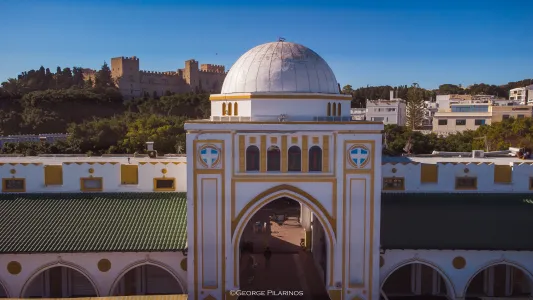
I almost didn't go.
That's the thing about the best travel decisions — they're usually the ones made on impulse, scribbled on a napkin, booked at midnight when sensible people are asleep. I'd been staring at a screen for six consecutive weeks, the kind of working stretch that makes you forget what sunlight feels like. A friend sent a link. Rhodes tours, last-minute availability, departing Friday. I typed in my card number before I had time to talk myself out of it.
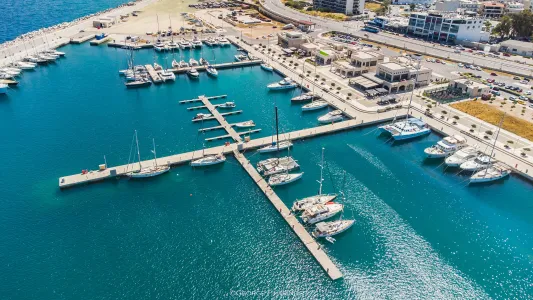
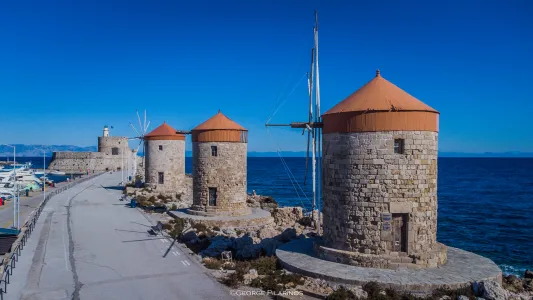
Three days later I was standing on a ferry deck watching the outline of Rhodes rise from the Aegean like something out of a mythology textbook. That first silhouette — the old city walls glowing amber in the early morning, the minarets and bell towers competing for sky — was enough to tell me I had made the right call.
Day One: Old Town, Old Souls
Our first full day began in Rhodes Old Town, and our guide, a quietly knowledgeable woman named Elena, had the rare gift of making history feel lived-in rather than lectured. She walked us through the Gate of St. John as though she'd done it ten thousand times and still found it miraculous, which I suspect she had and did.
The Street of the Knights is one of those places that photographs poorly, not because it isn't beautiful, but because beauty that old and that specific resists compression into a rectangle. The stones are worn glassy. The air smells faintly of something you can't name — old wood, citrus, the sea behind every wall. Elena told us about the Knights Hospitaller who ruled here for over two centuries, their coats of arms still carved into lintels above doorways that now lead to souvenir shops and family-run tavernas. History doesn't disappear in Rhodes, she said. It just changes what it sells.
We ate lunch in a courtyard so deep inside the old town that the sounds of tourism barely reached us. A plate of grilled octopus, still warm from the charcoal, dressed with nothing more than olive oil and lemon. A glass of local white wine that tasted like chalk and flowers. I made a note in my phone: This is what Rhodes tours should always feel like. Not performance. Not a script. Just honest access to a place that is genuinely extraordinary.
Day Two: The Road to Embonas
The second day took us inland, and this is where Rhodes revealed a side most visitors never see. The island's interior is mountainous, forested, and dramatically different from the coastline. Our small group drove up into the Attavyros range, the air cooling noticeably as we climbed, vineyards replacing hotels, goats replacing tourists.
Embonas is a village of perhaps eight hundred people, perched high enough that you can see both coasts on a clear day. We arrived at a family-run winery, three generations represented in the building at once — grandfather asleep in a chair by the door, his daughter managing the tasting room, her teenage son sulking about something on his phone in the corner, universally recognizable across cultures. We tasted wines made from Athiri and Mandilaria grapes, varieties that have been grown on this island for three thousand years. The grandfather woke up briefly, assessed us, nodded once with apparent approval, and went back to sleep.
Lunch was at a long wooden table under a pergola, the kind of meal that ruins restaurant dining forever because nothing quite compares afterward. Lamb slow-cooked until it conceded entirely. Roasted vegetables that tasted of actual sunshine rather than a grow-light approximation. Bread pulled fresh from a stone oven. We ate for two hours, talked to strangers from four different countries, and collectively decided that everything we'd worried about before this trip was probably fine.
This, specifically, is what I think the best Rhodes tours offer: not a checklist of landmarks, but a recalibration. A reminder that most things are, in fact, fine, and that some things are considerably better than fine.
Day Three: Lindos and the Long View
No visit to Rhodes is complete without Lindos, and no amount of advance preparation entirely prepares you for it. The village tumbles down a hillside in a cascade of white cubic houses, all of them somehow simultaneously blinding and elegant in the midday light. Above it all sits the ancient acropolis, and the view from the top — the circular bay below, the Aegean spreading outward without apparent limit, the sky so blue it seems digitally enhanced — is one of those views that prompts involuntary silence.
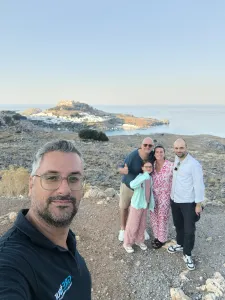
Elena had warned us to visit early, before the heat and the crowds arrived in force. We made it up to the temple of Athena Lindia before nine, when the light was still low and golden and the few other visitors present were mostly, like us, people who'd gotten up at an unreasonable hour to earn the moment. Standing among those ancient columns, looking out over water that hasn't changed in three millennia, you feel the particular vertigo of deep time — the dizzying sense that you are very small and very brief, and that this is somehow a comfort rather than a catastrophe.
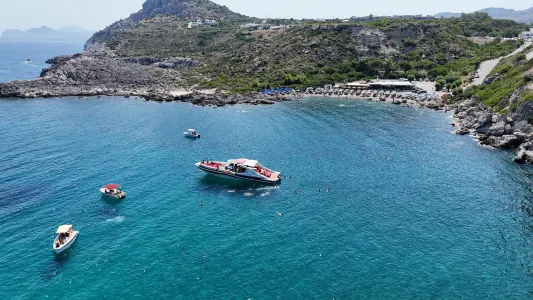
We spent the afternoon on the small beach below the acropolis, swimming in water so clear it seemed like a special effect. Nobody spoke much. Nobody needed to.
The Thing About Rhodes
On the ferry home, sunburned and carrying a bottle of wine I'd been advised not to check in my luggage, I tried to work out why Rhodes had affected me the way it had. It wasn't any single place or meal or view, though there were many worth cataloguing. It was something about the accumulated effect of three days spent entirely in the present tense — no planning, no inbox, no future to optimize. Just this street, this meal, this sea, this light.
Good Rhodes tours don't take you to an island. They return you to yourself.
I booked my return flight before the ferry docked.